


Stem Cells
Stem cells are unspecialized cells that can divide and give rise to specialized cell types. The science is real and the clinical record is narrow: a small number of approved products, a large and largely unapproved commercial market, and a regulatory position from the FDA that is unusually direct. This page sets out what is established, what is not, and where a formulation company does and does not have a role.
The main types
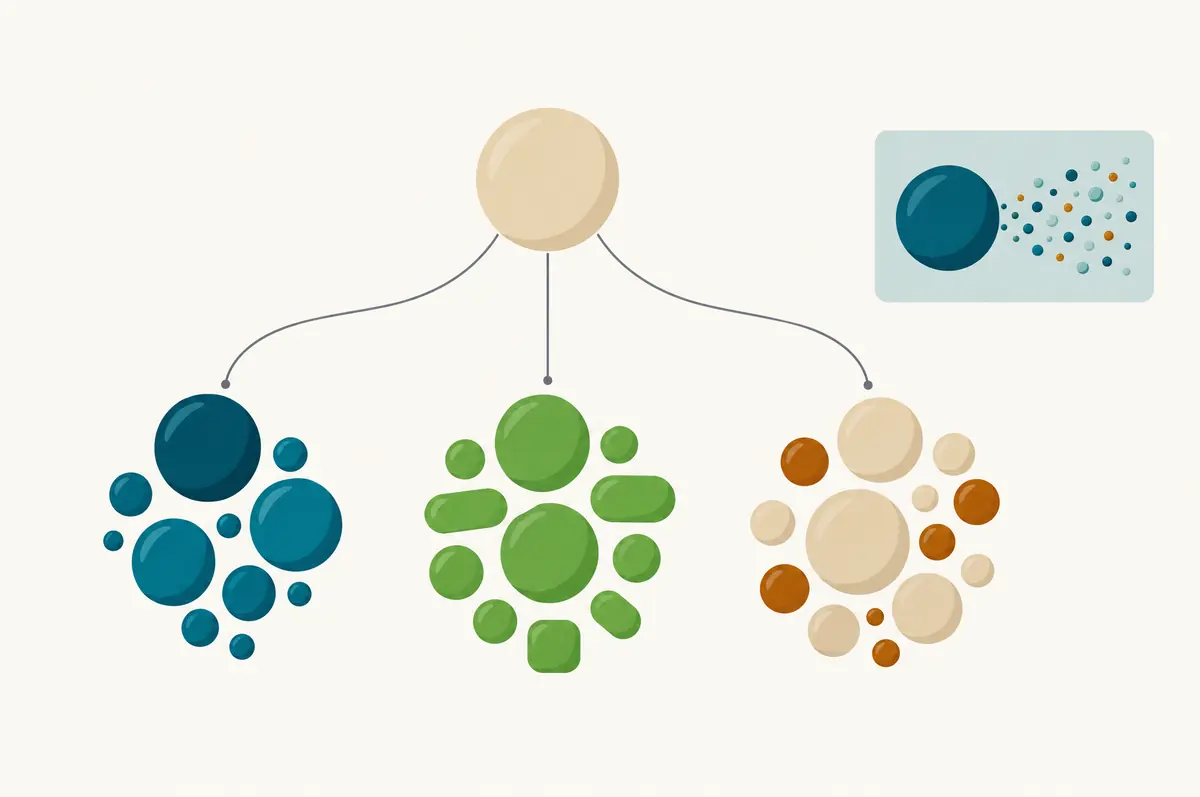
Hematopoietic stem cells form blood and immune cells and are the basis of bone marrow and cord blood transplantation. Mesenchymal stromal cells, often taken from bone marrow, fat or umbilical cord tissue, are the cells behind most commercial offerings; they are not true stem cells in the strict sense and much of their studied activity is attributed to the factors they secrete rather than to engraftment. Induced pluripotent stem cells are reprogrammed adult cells used mainly in research and early trials. Embryonic stem cells remain research tools in most jurisdictions.
What is actually approved
In the United States, the FDA has approved cord blood-derived hematopoietic products for disorders affecting blood production, and in December 2024 approved Ryoncil, a bone marrow-derived mesenchymal stromal cell therapy, for steroid-refractory acute graft-versus-host disease in patients 2 months and older. That approval was the first for a mesenchymal stromal cell product. Everything sold outside those indications for orthopedic, neurological, cardiovascular, cosmetic or anti-aging purposes is, in the FDA's own words, not approved for those uses.
The consumer market and the warnings
The FDA has issued repeated public warnings about clinics marketing unapproved stem cell and exosome products, including safety alerts following infections and other serious harms. Cosmetic products marketed with stem cell language usually contain no viable cells at all; what is in the bottle is conditioned media, cell lysate or plant cell culture extract, and in the European Union substances of human origin are prohibited in cosmetics outright. Reading the ingredient list rather than the marketing is the fastest way to tell what a product is.
The delivery questions for cells
Cells are not molecules and they do not behave like a payload. The formulation questions are cryopreservation and thaw survival, protection from shear during handling, immune shielding, and keeping cells alive and positioned after administration. Encapsulation of living cells in alginate and similar hydrogels is a long-running research field, distinct from the nanoscale encapsulation we do. A cell will not fit inside a nanoparticle; a cell can be enclosed in a hydrogel bead the size of a grain of sand.
Where Vegalab works
Vegalab works in the cell-free space: stabilizing the proteins and growth factors that cells secrete, and the vesicles they release, for cosmetic and research use. These are the materials where our layered shells add the most, holding fragile biological cargo intact through a finished base, a drying step and a shelf life.
Key facts
- The FDA approved Ryoncil (remestemcel-L-rknd) on December 18, 2024, the first mesenchymal stromal cell therapy approved in the United States, for steroid-refractory acute graft-versus-host disease in patients 2 months and older (FDA, 2024)
- Only blood-forming stem cells from umbilical cord blood are FDA approved among stem cell products, and only for disorders affecting blood production (FDA Consumer Alert, current as of April 2024)
- The FDA has issued public safety alerts about unapproved stem cell and exosome products following reports of serious harm (FDA Public Safety Alert)
- Substances of human origin are prohibited in cosmetic products in the European Union (Regulation (EC) 1223/2009, Annex II)
How our delivery technology applies
Our contribution in this area is cell-free: keeping secreted proteins and vesicles intact in a finished base through surfactants, pH shifts, shear and shelf life, for cosmetic and research programs. The endpoints are measurable, which makes every program specifiable.
Questions
Does Vegalab work with stem cells?
Vegalab works with what stem cells produce: secreted proteins and extracellular vesicles, stabilized for cosmetic and research formulations. Living cell therapies are made by licensed cell therapy manufacturers.
Related reading
Last updated: