


Nature's Carrier, and Its Limits
Exosomes are frequently called nature's delivery vehicle. They do carry cargo between cells, and that has made them one of the most studied ideas in drug delivery. The gap between the idea and a usable product is large, and it is mostly about reproducibility, stability and dose definition. This page compares vesicles with the carriers we build and says where each makes sense.
Why vesicles attract interest
A small extracellular vesicle is a lipid bilayer built by a cell, carrying that cell's proteins, lipids and RNA. It is already the size of a nanoparticle, it is made of endogenous material, and it carries surface proteins that may direct it to particular cell types. For a delivery scientist that combination is compelling: a carrier that the body already produces and already recognizes.
What makes them hard to use
Isolation method changes what is in the preparation. Ultracentrifugation, size-exclusion chromatography, precipitation and tangential flow filtration give different purity, yield and contaminant profiles, which is a large part of why results have been hard to reproduce across laboratories. Dose is also unresolved: particles per milliliter, protein content and activity are not interchangeable units. The MISEV guidelines exist because of exactly these problems, and they set minimum reporting standards for any serious work.
Loading a vesicle is not simple
Getting a chosen payload into a vesicle means either engineering the parent cell to package it or loading afterward by electroporation, sonication, incubation or surfactant treatment. Every post-loading method that is efficient also damages membranes, and every gentle method is inefficient. Loading efficiency, membrane integrity and aggregation have to be reported together or the number means little.
Side by side with engineered carriers
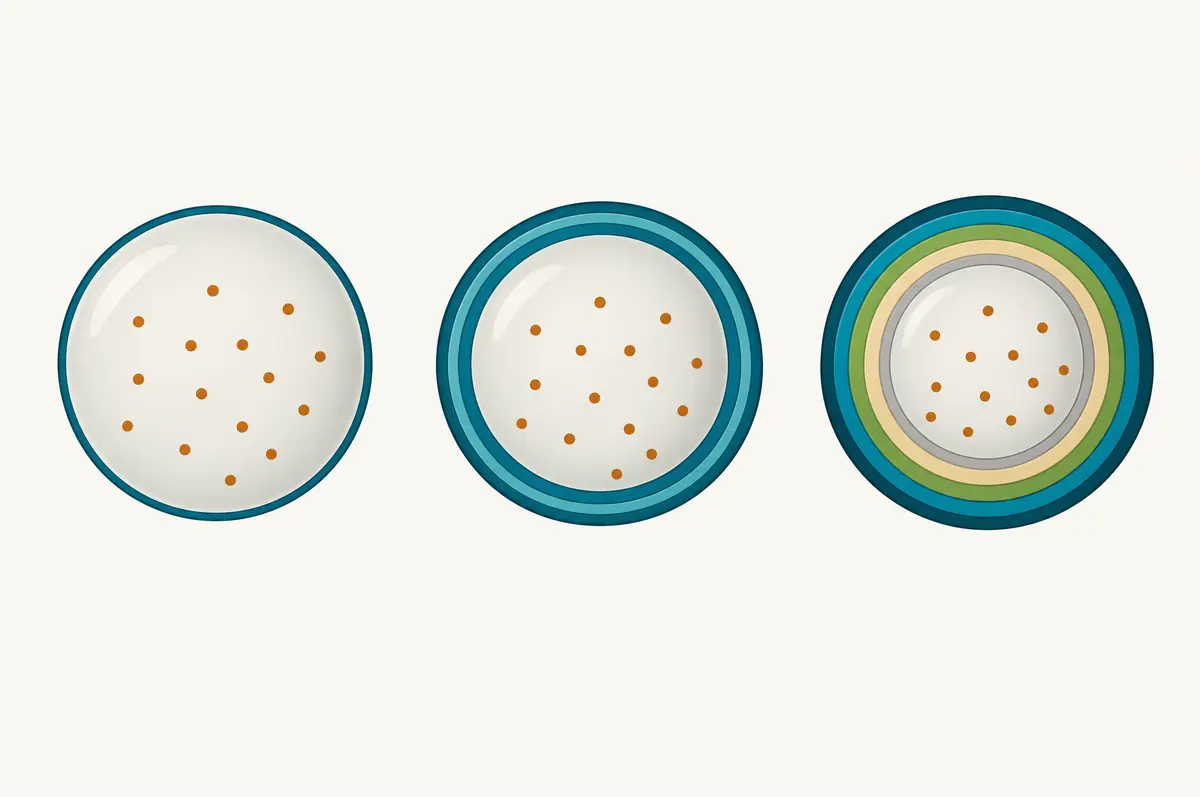
A liposome is defined, manufacturable and characterizable, but it is a single bilayer with limited functional control. A lipid nanoparticle is the workhorse for nucleic acid payloads and has a well-established manufacturing base. Our layered biopolymer shell is built outward from a core, which allows different jobs per layer: barrier, pH trigger, mucoadhesion, release timing. A vesicle offers biological sophistication that none of these match, and in exchange it gives up batch consistency and shelf life. That trade sits at the center of every serious comparison.
The combination we find interesting
Rather than competing with vesicles, our platform can house them. An outer biopolymer layer can buffer a vesicle against surfactants, pH shifts and shear in a finished product, and a sugar-rich matrix can act as a lyoprotectant during drying. The measurable endpoints are vesicle size distribution, particle count and marker retention before and after encapsulation and across shelf life. Our vesicle programs cover plant-derived and cosmetic-grade vesicles.
Key facts
- There are currently no FDA-approved exosome products, and exosome products intended to treat disease require approval as biological products (FDA Consumer Alert, current as of April 2024)
- The MISEV2023 guidelines set minimum reporting requirements for extracellular vesicle studies and recommend operational terms such as small EVs where biogenesis is not demonstrated (Welsh et al. 2024, J Extracell Vesicles 13:e12404)
- Isolation method changes extracellular vesicle purity, yield and characterization, contributing to poor reproducibility across studies (Thery et al. 2018, MISEV2018)
- Substances of human origin are prohibited in cosmetic products in the European Union (Regulation (EC) 1223/2009, Annex II)
How our delivery technology applies
We build shells; a vesicle is a shell the cell built. Our layers protect theirs through formulation and shelf life, and every program is specified by defined stability endpoints.
Questions
Can Vegalab encapsulate exosomes?
Yes. Our layers house plant-derived and cosmetic-grade vesicles and protect them from surfactants, pH shifts, shear and drying. Each program is specified by vesicle size, particle count and marker retention across shelf life.
Send your vesicle source and characterization data to scope a stability feasibility study.
Related reading
Last updated: