


How do you get rid of fleas in the yard?
Last updated:
Treat your pets first, then the shaded, sheltered spots where they rest, not the whole lawn. Cat flea larvae need humid, protected places, and areas in full sun or with heavy foot traffic rarely hold them1. Outdoor treatment focuses on doghouses, kennel areas, fence lines, under decks and along foundations, using a product with an insect growth regulator and following the product label2.
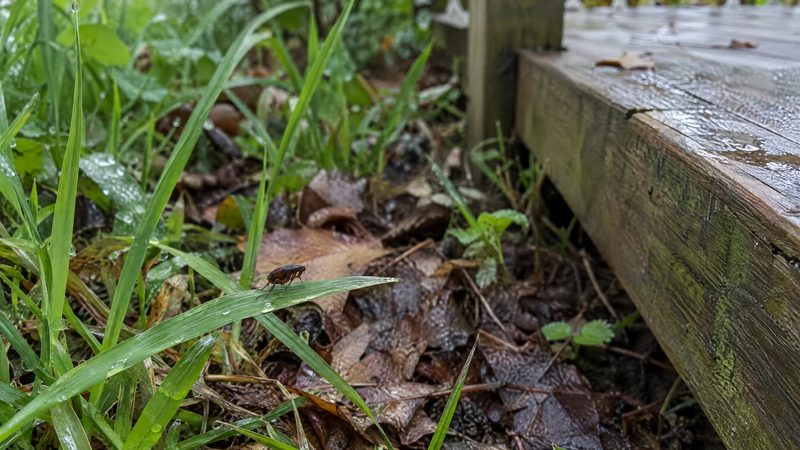
Where do fleas live in a yard?
The flea in most yards is the cat flea (Ctenocephalides felis), which despite its name attacks both dogs and cats and also bites people1. Adult cat fleas stay on the animal, where they feed, mate and lay eggs; a female lays about 20 to 50 eggs a day, and the eggs fall off wherever the pet rests1. Wildlife such as opossums and raccoons can also seed fleas into outdoor areas2.
What you are treating outdoors is mostly the immature stages1. Larvae feed on dried blood and the droppings of adult fleas, develop only where relative humidity is at least 75%, and prefer temperatures of 70 to 90 degrees F1. That keeps them in shaded, protected places such as sheltered animal enclosures, crawl spaces where feral animals sleep, and vegetated areas next to buildings1. Larvae are unlikely to survive in areas exposed to sunlight or substantial foot traffic1.
| Stage | Where it is | How long it lasts |
|---|---|---|
| Egg | Laid in the pet's fur, then falls to resting areas1,2 | Hatches in about 2 to 5 days1 |
| Larva | Shaded, humid spots with flea droppings to eat1 | Feeds and crawls for 8 to 15 days1 |
| Pupa in cocoon | Same sites, camouflaged with debris1 | Normally 7 to 14 days, longer in some conditions3; up to 12 months at cool temperatures1 |
| Adult | On the pet1 | About 30 to 40 days on the host1 |
In North America, flea numbers rise sharply in spring and early summer, when conditions favor larval development1, so April is the time to check pet resting areas and start prevention; in some regions protection runs year round2. In the Southern Hemisphere the same build-up comes in spring and early summer, roughly September to December.
How do you know if your yard has fleas?
Walk the places your pets rest wearing white socks pulled up to the knee; if fleas are present, they jump onto the socks and are easy to see1,2. On the pet, digested blood passed by fleas shows up as dark, pepper-like specks in the fur2.
Most flea problems can be eliminated by treating the pet and, if needed, the inside of the home2. Outdoor sprays are not necessary unless you find significant numbers of adult fleas1. Yard treatment is most useful when pets spend most of their time outdoors2.
What is the best way to treat fleas in the yard?
Treat where the pets rest, sleep and run: doghouse and kennel areas, along fences, under decks, under shrubbery and next to the foundation2,3. It is seldom necessary to treat the entire yard or lawn, or areas in full sun, because fleas prefer not to develop there1,2. Well-maintained lawns in sunny sites are unlikely to harbor many fleas3.
Insect growth regulators are the standard outdoor tool2,3. Formulations containing pyriproxyfen prevent flea eggs and larvae from developing for several months2. Pyriproxyfen is more stable outdoors than methoprene, which breaks down quickly in direct sunlight and is used mainly indoors3. Many field populations of cat fleas are resistant to pyrethroids such as permethrin, which limits options for killing adult fleas outdoors1. Whatever you choose, use a product labeled for outdoor flea control and follow the product label.
Timing matters. Premise treatments work best when made at the same time the pet is treated3. Pupae inside their cocoons are well protected from sprays and often survive to emerge several days later, so follow-up treatments are usually needed3. Never use products made for carpets or yards on the pets themselves2.
- Open up pet resting areas to sunlight by removing low-hanging vegetation; immature fleas are unlikely to survive in sun1.
- Limit food, water and shelter for feral cats, opossums, squirrels and other wildlife that bring fleas onto the property1.
- Keep pets on a preventive flea product so stray fleas they pick up are killed before they lay eggs2.
Do beneficial nematodes work on fleas in the yard?
The insect-killing nematode Steinernema carpocapsae can infect cat fleas4. In a controlled study, applying it to potting soil, sand or gravel containing flea eggs, larvae or pupae reduced the number of adult fleas that emerged, with effects in sand and gravel equal to or greater than in soil4. Pupae were susceptible whether they were in silk cocoons, sand-and-silk cocoons or no cocoon at all, and infection rose as more nematodes were present4.
Cornell's fact sheet on S. carpocapsae lists cat fleas in yards and turf, but the supporting evidence is a laboratory or greenhouse study rather than a field trial5. The nematodes are living organisms with strict handling needs: sunlight is extremely damaging to them, they must not dry out, and they work at soil temperatures of about 70 to 85 degrees F5. Apply them in the early morning or evening, water before and after, and keep the soil moist for at least two weeks5.
Commercial strains generally do not persist in the soil, so plan on reapplying5. The shaded, humid spots where flea larvae develop are also the conditions nematodes need, which makes pet resting areas the logical target1,5. Under federal rules, living biological control agents are exempt from FIFRA pesticide requirements, except microorganisms such as bacteria, fungi and protozoa, and viruses6.
Do home remedies for fleas in the yard work?
Most popular remedies have little evidence behind them1,3. Garlic, brewer's yeast, cedar bedding and herbal collars and sachets are widely promoted, but little scientific evidence supports them, and brewer's yeast has been tested without showing any protection for pets3. Neither thiamine supplements nor brewer's yeast prevents fleas from feeding, and herbal collars and ultrasonic devices are not effective repellents1.
Diatomaceous earth is unlikely to give practical flea control outdoors, based on laboratory evaluations at Texas A&M AgriLife Extension, because it works as a drying agent only in dry conditions3. Mixing it with water and spraying it appears to stop fleas from picking up the dust3. It can kill flea larvae when applied as a dust to dry sites such as pet houses and pet bedding3; if you use it, follow the product label.
| Remedy | What the evidence shows |
|---|---|
| Garlic or brewer's yeast for the pet | Little evidence; brewer's yeast showed no protection when tested3 |
| Thiamine (vitamin B1) supplements | Does not prevent fleas from feeding1 |
| Cedar chips or bedding | Volatile oils kill some fleas, but the effect is probably short-lived3 |
| Herbal collars and ultrasonic devices | Not effective as flea repellents1 |
| Diatomaceous earth outdoors | Unlikely to give practical control; works only in dry conditions3 |
| More sun on resting areas | Immature fleas are unlikely to survive in sunlit areas1 |
How do you keep fleas from coming back?
Keep pets protected year round or through the flea season, depending on where you live, so new fleas die before they lay eggs2. Start on-animal products early in the year, before populations build, to keep fleas from establishing1. Vacuum floors, rugs and furniture regularly and launder pet bedding in hot, soapy water at least once a week, since vacuuming also pulls fleas out of their cocoons1.
After a treatment, expect new adults to keep appearing for a while: sprays do not kill pupae, so fleas can continue to emerge for about 2 weeks1. Keep vacuuming through that period rather than retreating straight away1.
Key takeaways
- Treat the pet first; most flea problems end with pet treatment and, if needed, the indoor areas.
- Outdoors, treat only shaded pet resting areas, fence lines, decks and foundations, not sunny lawn.
- Insect growth regulators such as pyriproxyfen are the outdoor tool; follow the product label.
- Beneficial nematodes infect flea larvae and pupae in tests, but need moist, shaded soil and repeat application.
- Garlic, brewer's yeast, herbal collars and outdoor diatomaceous earth are not reliable yard flea controls.
References
- Pest Notes: Fleas (UC ANR Publication 7419)
- Flea Control and Prevention (ENTFACT-602)
- Fleas (ENT-3001)
- The Effects of Steinernema carpocapsae (Weiser) Application to Different Life Stages on Adult Emergence of the Cat Flea Ctenocephalides felis (Bouche)
- Steinernema carpocapsae, beneficial nematode (Sc)
- 40 CFR 152.20, Exemptions for pesticides regulated by another Federal agency