


How is chlorine dioxide used to treat drinking water?
Last updated:
Chlorine dioxide (ClO2) is added to drinking water as an oxidizing disinfectant that inactivates bacteria, viruses and protozoa over a wide pH range without forming trihalomethanes3. Its residual in US public water is capped at 0.8 mg/L2. On farms it is used to sanitize drinking water and to break down biofilm in water lines, for example as a shock clean followed by a continuous low dose6.
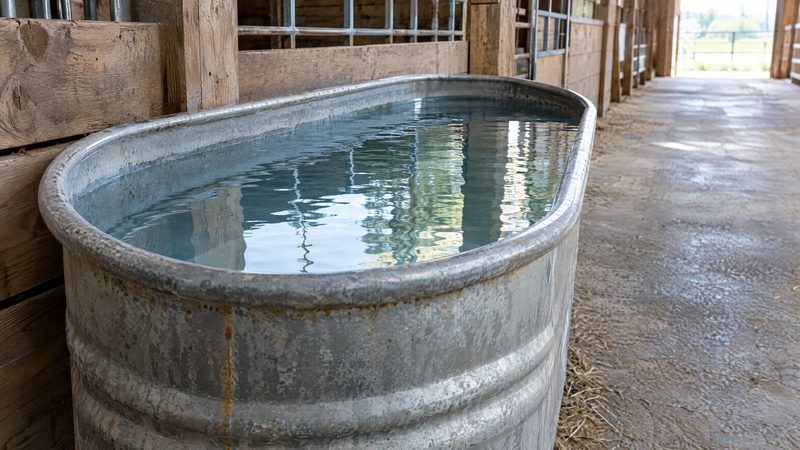
How does chlorine dioxide disinfect water?
Chlorine dioxide is a gas that dissolves in water, and because it is explosive under pressure it is usually produced on site, from sodium chlorate or sodium chlorite1. In water treatment it works through oxidation rather than chlorination, which means it does not form trihalomethanes3. Its antimicrobial action is most often explained by disruption of protein synthesis and loss of the permeability controls of cell walls and membranes3.
Chlorine dioxide inactivates bacteria, viruses and protozoa over a wide pH range3. That matters on farms, because a water pH of 7.0 or higher can reduce the sanitizing effectiveness of chlorine5. Chlorine dioxide can also penetrate biofilms, is the least corrosive of the oxidizing disinfectants, and is EPA-approved to treat potable drinking water4.
In water, chlorine dioxide is reduced to chlorite and chloride by reactions with organic carbon, and its breakdown to chlorite and chlorate is catalyzed by iron and copper1. It is stable in pure water in the dark but breaks down in sunlight1.
| Feature | Chlorine dioxide | Chlorine |
|---|---|---|
| Reaction type | Oxidation3 | Chlorination3 |
| Trihalomethanes | Not formed3 | Can form, as a chlorination by-product3 |
| Effect of pH | Active over a wide pH range3 | Effectiveness can drop at pH 7.0 or higher5 |
| Biofilm | Penetrates biofilms4 | Bound by microorganisms in biofilm, so levels fall along the line5 |
| US maximum residual disinfectant level | 0.8 mg/L as ClO22 | 4.0 mg/L as Cl22 |
In North America, biofilm pressure in drinker lines rises from late spring through summer, when warm house temperatures and low flow favor slime build-up, so lines are best cleaned and monitored closely heading into the warm season5. In the Southern Hemisphere the same warm-season pressure runs from about November to March.
What limits apply to chlorine dioxide and its by-products?
Under US national primary drinking water regulations, the maximum residual disinfectant level for chlorine dioxide in public water systems is 0.8 mg/L2. The World Health Organization sets no guideline value for chlorine dioxide itself, because any remaining at the tap is reduced to chlorite and chloride when swallowed; it sets provisional guideline values of 0.7 mg/L each for chlorite and chlorate1.
By-products track the dose: chlorite levels generally range from 30% to 70% of the chlorine dioxide dose, and chlorate is usually below about 20% of the dose1. The taste and odor threshold for chlorine dioxide in water is about 0.2 to 0.4 mg/L1. The WHO notes that difficulties in meeting the chlorite value must never be a reason for compromising adequate disinfection1.
How is chlorine dioxide used as a poultry drinking water sanitizer?
Water quality drives poultry health and production, because birds drink roughly twice as much water as they eat feed6. Low flow rates, warm house temperatures, bacteria and poor water quality all contribute to biofilm, a slime that clogs water lines and filters, restricts flow and protects bacteria from many sanitizers5. Many water sanitizers treat the water but do not remove a biofilm that is already present, so the organisms inside it stay protected5.
Chlorine dioxide is a strong oxidizer that is effective at breaking down biofilm in water lines6. A regimen that starts with a shock treatment to remove existing slime, followed by continuous low-concentration treatment, has been reported to reduce bacterial populations sharply and to improve flock health, body weight and feed conversion6. In a 2026 laboratory and pilot-farm study, chlorine dioxide reduced viable biofilm cells to below the quantification limit for three of four multispecies biofilm communities in the laboratory, yet the cleaning and disinfection protocols tested showed little effect on the farm itself7. The authors concluded that regular monitoring of water quality and biofilm presence is essential for treatment decisions7.
- Between flocks, flush lines at high pressure and use acid and alkaline cleaners to remove organic debris and mineral scale, so disinfectants can reach the remaining microorganisms6.
- Flush regularly during the flock, ideally daily in the starter period and at least once or twice a week afterward6.
- Flush after vitamins and electrolytes, whose organic carriers accelerate biofilm regrowth6.
- Confirm the product is compatible with the rubber, plastic and metal parts of the drinker system5.
- Verify the chlorine dioxide concentration before use, because commercial products vary widely; one university guide recommends products certified to NSF/ANSI Standard 60 for drinking water treatment4.
- Follow the product label for the concentration that applies with birds present and for line cleaning with birds absent.
How do you check that water line treatment is working?
Measure at both ends of each line: microorganisms in biofilm bind disinfectant, so a lower reading at the end of the line than at the start points to biofilm, and oxidation-reduction potential (ORP) also falls along a line when biofilm or bacteria are present5. ORP is measured in millivolts, and higher readings are normally associated with better bactericidal action5.
Look for slime at regulators, filters, filter housings, medicator pumps and inside the pipe, and watch for drops in water pressure5. If a problem is suspected, have the well water and water lines tested for bacteria5. Newer monitoring systems track pH, temperature and ORP in real time so treatment can be adjusted automatically, although most such closed-loop systems are still at the prototype or early commercial stage6.
What are chlorine dioxide tablets, and how are they used?
Water disinfection tablets containing chlorine, iodine, chlorine dioxide or other disinfecting agents are sold online and at pharmacies and sporting goods stores, and the EPA advises following the instructions on the product label because each product may have a different strength8. Disinfection does not work as well in cloudy or colored water, so let it settle and filter it through a clean cloth, paper towel or coffee filter first8.
Chlorine dioxide is produced by acidifying sodium chlorite, and solid formats exist in which sodium chlorite impregnated in a carrier such as calcined clay is treated with an acid to release chlorine dioxide3. For livestock water, PureTabs are effervescent tablets that dissolve in water to release a pre-measured dose of chlorine dioxide, used for water treatment in stock tanks and drinkers, with tablets per liter and contact time set by the registered label for each market.
What precautions apply to handling chlorine dioxide?
Chlorine dioxide gas is explosive under pressure, and good process control is essential wherever the gas is made and used1. US occupational exposure limits for chlorine dioxide are 0.1 ppm as a time-weighted average and 0.3 ppm for short-term exposure1. Because it breaks down in sunlight and reacts with organic matter and metals such as iron and copper1, prepared solutions lose strength in open, sunlit tanks and dirty lines. Read and follow the product label for mixing, storage and protective equipment.
Key takeaways
- Chlorine dioxide disinfects by oxidation, works over a wide pH range and forms no trihalomethanes.
- The US cap for chlorine dioxide in public drinking water is 0.8 mg/L, and the WHO sets provisional values of 0.7 mg/L for its by-products chlorite and chlorate.
- In poultry water lines it is used against biofilm, often as a shock clean followed by a continuous low dose.
- Biofilm can persist after treatment, so measure residual and ORP at the start and end of each line and test for biofilm directly.
- Chlorine dioxide tablets vary in strength, so dose by the product label.
References
- Chlorine Dioxide, Chlorite and Chlorate in Drinking-water: Background document for development of WHO Guidelines for Drinking-water Quality (WHO/FWC/WSH/16.49)
- 40 CFR 141.65: Maximum residual disinfectant levels
- Sodium Chlorite for Generation of Chlorine Dioxide Gas, Handling/Processing: Technical Evaluation Report
- Chlorine Dioxide as a Livestock Operation Disinfectant
- Broiler Tip: Biofilms in Poultry Drinking Systems
- Recent advancements to improve drinking water quality in poultry farms
- Laboratory and pilot-farm evaluation of cleaning and disinfection protocols for biofilms in livestock drinking water systems
- Emergency Disinfection of Drinking Water
Frequently asked questions
How long does chlorine dioxide last in water?
Chlorine dioxide is stable in pure water kept in the dark, but sunlight breaks it down to chlorate, chlorite and chloride1. In normal water it is also consumed by organic carbon, and its breakdown is catalyzed by iron and copper1. That is why residual is measured at the end of the line rather than assumed from the dose.
Does chlorine dioxide change the taste of water for animals or people?
What is the difference between sodium chlorite and chlorine dioxide?
Can chlorine dioxide be used while birds are drinking?
Yes. One documented regimen starts with a shock treatment to remove existing slime and follows it with continuous low-concentration treatment of the drinking water6. Follow the product label for the concentration that applies when animals are present.