


Why is curcumin poorly absorbed?
Last updated:
Curcumin is poorly absorbed because it barely dissolves in water, breaks down within minutes at neutral pH, and the small share that is absorbed is quickly converted to glucuronides and sulfates5,1,4. Most swallowed curcumin leaves the body unabsorbed in the feces, and free curcumin in the blood stays in the low micromolar range or below4,5.
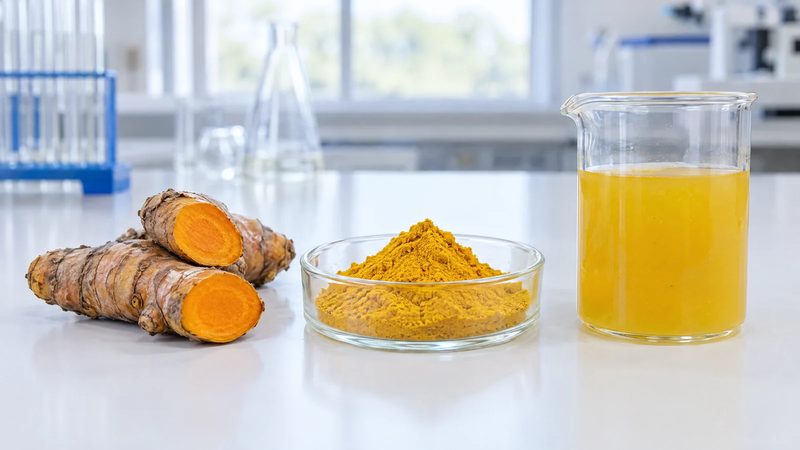
What makes curcumin so hard to absorb?
Curcumin is the compound that gives turmeric (Curcuma longa), a plant in the ginger family, its yellow color6. Commercial curcumin is a mixture of three curcuminoids: curcumin at roughly 75%, demethoxycurcumin at about 15% and bisdemethoxycurcumin at about 5%4. Its potential is limited by poor solubility, low absorption from the gut, rapid metabolism and rapid elimination4.
Solubility is the first wall. Curcuminoids dissolve well in organic solvents but very poorly in water: in an aqueous buffer at pH 5.0, curcumin dissolves to only about 11 nanograms per milliliter5. Curcumin also switches between two chemical forms. The keto form is stable in acid but insoluble in water, while the enol form dissolves in water but is unstable above pH 75.
Size and shape add a second problem. Many plant polyphenols have multi-ring structures too large for easy passive diffusion, and highly lipophilic ones such as curcumin cannot dissolve in the watery fluids of the gut, so they struggle to reach and cross the intestinal lining7.
What happens to curcumin in the gut and liver?
Curcumin that does dissolve meets an unfriendly pH. In a laboratory study, about 90% of curcumin incubated in phosphate buffer at pH 7.2 and body temperature decomposed within 30 minutes1. Breakdown depended on pH and ran faster in neutral to basic conditions; vanillin, ferulic acid and feruloyl methane were among the degradation products1. The same study found curcumin far more stable in human blood and in culture medium containing serum, where less than 20% decomposed within an hour1.
Most ingested curcumin is never absorbed and is excreted in the feces unchanged4. The small portion that is absorbed is extensively converted to water-soluble glucuronides and sulfates, and gut microbes also reduce curcumin to dihydrocurcumin and tetrahydrocurcumin4. This rapid metabolism takes place in both the intestinal wall and the liver2.
| Barrier | What happens | Source |
|---|---|---|
| Dissolving in gut fluid | Solubility of about 11 nanograms per milliliter in pH 5.0 buffer | 5 |
| Chemical stability | About 90% decomposed in 30 minutes at pH 7.2 and 37 C | 1 |
| Absorption | Most ingested curcumin passes out in the feces unchanged | 4 |
| Metabolism | Absorbed curcumin is rapidly converted to glucuronides and sulfates in the gut wall and liver | 2,4 |
How much curcumin actually reaches the blood?
Very little in its free form. In a 2006 dose-escalation study, 24 healthy volunteers received single servings of a standardized curcuminoid extract ranging from 500 to 12,000 milligrams; no curcumin was detected in serum at any amount up to 8,000 milligrams, and low levels appeared in only two people at the two highest amounts3. Minimal side effects were reported in 7 of the 24 participants and did not appear to depend on the amount3.
Later work using mass spectrometry reached a similar conclusion: because of poor absorption, rapid metabolism and rapid elimination, unconjugated curcumin in human blood does not exceed the low micromolar range even after very large oral intakes5. That is why studies such as these measure curcumin together with its metabolites rather than free curcumin alone4,5.
Does piperine improve curcumin bioavailability?
Piperine, a compound from black pepper, inhibits glucuronidation in the liver and intestinal wall, one of the main routes that clears curcumin2. In a 1998 study, curcumin given alone to healthy volunteers produced serum levels that were undetectable or very low, and adding a small amount of piperine raised curcumin bioavailability by 2000%2. In rats, the same combination raised bioavailability by 154%2. The US National Center for Complementary and Integrative Health describes combining curcumin with piperine as one way to improve its bioavailability6.
Newer data are less clear-cut. In a 2021 crossover study of 30 healthy adults that measured 3 curcuminoids and 12 metabolites, a commercial piperine and curcuminoid combination showed no significant difference in total curcuminoid exposure from a standard turmeric extract5. The two studies differ in product, analytical method and what was counted, which is a reminder that a fold-increase figure belongs to its own study design.
How do curcumin formulations compare on bioavailability?
Formulators have tried several routes around curcumin's limits. Phospholipid complexes (phytosomes) improve the water solubility of lipophilic polyphenols such as curcumin7. Other approaches pair curcumin with turmeric volatile oils, hydrophilic carriers and cellulose derivatives, micelle-forming agents, or colloidal suspensions4,5.
Two head-to-head human studies give a sense of the spread. In a randomized, double-blind crossover study of 12 healthy volunteers, total curcuminoids in blood were 1.3-fold higher for a turmeric-oil formulation, 7.9-fold higher for a phytosome and 45.9-fold higher for a formulation with a hydrophilic carrier, cellulosic derivatives and antioxidants, each compared with unformulated curcumin4. In the 2021 study of five products, a liquid micellar preparation delivered the highest total curcuminoids, and the dried colloidal suspension gave higher total absorption than either the piperine or the phytosome product5. Yet exposure to unconjugated curcuminoids varied widely within participants and did not differ significantly between any of the formulations5.
| Formulation approach | Reported result | What was measured |
|---|---|---|
| Curcumin with piperine | 2000% higher bioavailability than curcumin alone (1998)2; no significant difference from standard extract (2021)5 | Serum curcumin (1998); total curcuminoids and metabolites (2021) |
| Phospholipid complex (phytosome) | 7.9-fold higher than unformulated curcumin4; lower total absorption than a dried colloidal suspension5 | Total curcuminoids after enzymatic deconjugation4,5 |
| Turmeric volatile oil formulation | 1.3-fold higher than unformulated curcumin4 | Total curcuminoids after enzymatic deconjugation4 |
| Hydrophilic carrier with cellulosic derivatives and antioxidants | 45.9-fold higher than unformulated curcumin4 | Total curcuminoids after enzymatic deconjugation4 |
| Liquid micellar preparation | Highest total curcuminoids of five products tested5 | Total curcuminoids including all metabolites5 |
How should you read a curcumin bioavailability claim?
Start with what was measured. Because free curcumin is so hard to detect, studies such as these treat plasma with glucuronidase and sulfatase enzymes before analysis, so the result counts conjugated metabolites as well as free curcumin4,5. A formulation can raise total curcuminoids significantly while showing no significant difference in free curcuminoids5.
Next, check the comparator and the sponsor. Fold increases are relative to a reference product, and the reference differs from study to study4,5. In the 2021 comparison, four authors were employees of the company that makes the colloidal suspension being tested5. Product content also varies: oral curcumin products differ in how much curcumin they contain and often include other plant substances such as piperine6.
Finally, higher absorption is not automatically better. The National Center for Complementary and Integrative Health notes that highly bioavailable curcumin formulations may harm the liver, and that more research is needed to understand how bioavailability affects curcumin's effects6.
Key takeaways
- Curcumin dissolves poorly in water and about 90% degraded within 30 minutes in a pH 7.2 buffer at body temperature.
- Most swallowed curcumin is excreted unabsorbed, and the absorbed share is rapidly converted to glucuronides and sulfates.
- Piperine raised curcumin bioavailability by 2000% in a 1998 human study, but a 2021 comparison found no significant gain over a standard extract.
- Formulation gains ranged from 1.3-fold to 45.9-fold for total curcuminoids in one study, while another found no significant difference in free curcuminoids between formulations.
- Highly bioavailable curcumin formulations may harm the liver, according to US federal guidance.
References
- Stability of curcumin in buffer solutions and characterization of its degradation products
- Influence of piperine on the pharmacokinetics of curcumin in animals and human volunteers
- Dose escalation of a curcuminoid formulation
- Comparative absorption of curcumin formulations
- Pharmacokinetics of a Single Dose of Turmeric Curcuminoids Depends on Formulation: Results of a Human Crossover Study
- Turmeric
- Phyto-phospholipid complexes (phytosomes): A novel strategy to improve the bioavailability of active constituents